
Starting a business is an exciting step, but choosing the right corporate structure is just as important as choosing the right business idea. If you’re planning to start a business in Ontario, you may have come across two common options: a Standard Corporation and a Professional Corporation.
While both structures offer many of the benefits of incorporation, they are designed for different purposes and come with different legal requirements.
In this guide, we’ll compare Professional Corporations and Standard Corporations in Ontario side by side, explain who qualifies for each, discuss incorporation costs, and help you determine which option is best for your situation.
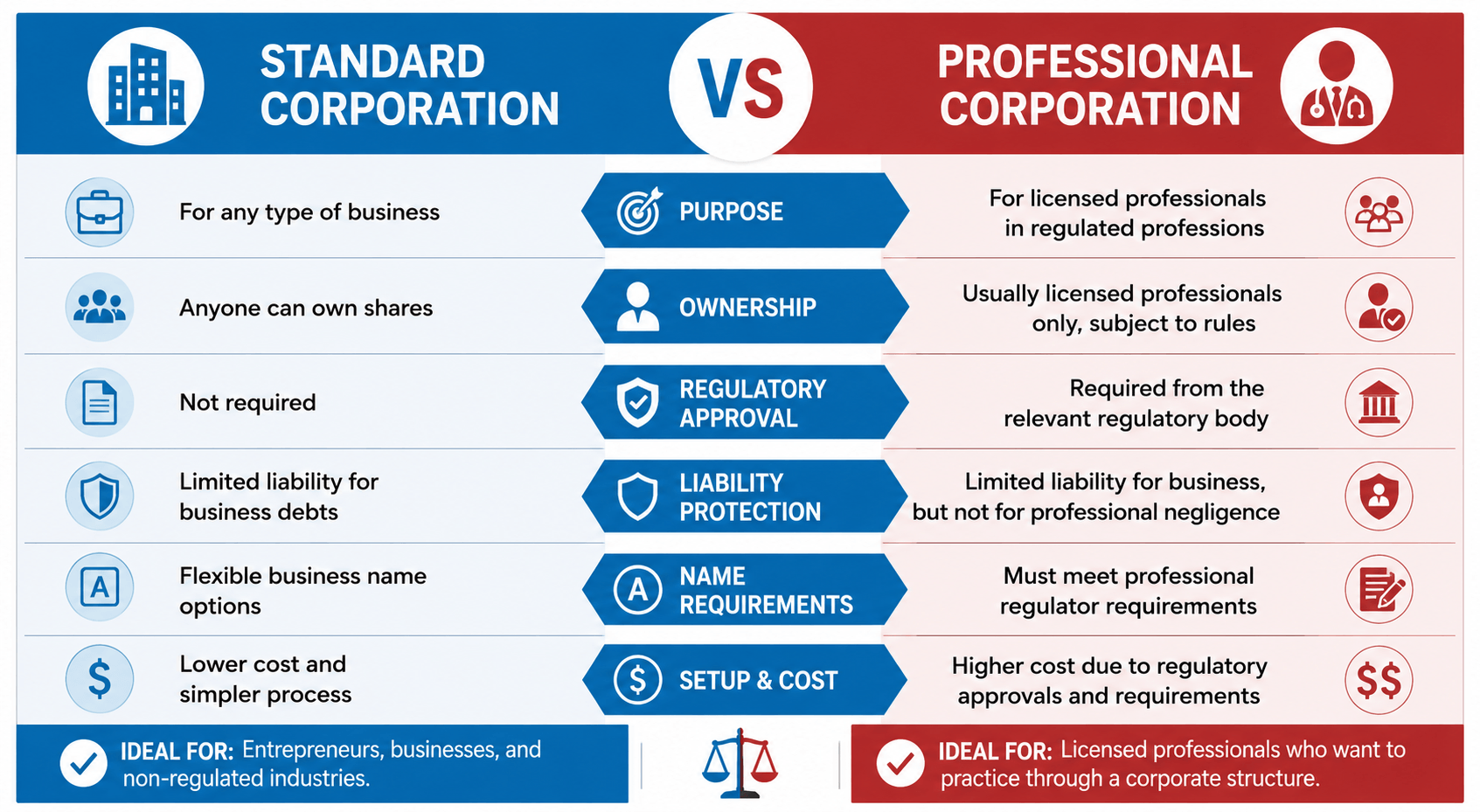
What Is a Standard Corporation in Ontario?
A Standard Corporation is the most common type of corporation used by entrepreneurs and business owners throughout Ontario.
When you incorporate a business in Ontario, you create a separate legal entity that exists independently from its owners. This means the corporation can own assets, enter contracts, borrow money, and be held liable for its own debts.
Standard corporations are suitable for:
- Retail businesses
- Construction companies
- Consultants
- Marketing agencies
- E-commerce businesses
- Technology startups
- Manufacturers
- Service-based businesses
Most small and medium-sized businesses in Ontario operate through a standard corporation.
Key Benefits of a Standard Corporation
- Limited liability protection
- Potential tax advantages
- Easier access to financing
- Greater business credibility
- Perpetual existence
- Flexible ownership structure
What Is a Professional Corporation in Ontario?
An Ontario professional corporation is a special type of corporation created specifically for regulated professionals.
Certain professions in Ontario are governed by regulatory bodies that allow members to practice through a professional corporation.
Examples include:
- Physicians
- Dentists
- Lawyers
- Accountants
- Chiropractors
- Veterinarians
- Pharmacists
- Architects
- Engineers (in certain circumstances)
Unlike a standard corporation, a professional corporation can only be owned by licensed members of the applicable profession, subject to regulatory requirements.
The process of Ontario professional incorporation requires approval or certification from the relevant regulatory authority before the corporation can legally operate as a professional corporation.
Professional Corporation vs Standard Corporation: Quick Comparison
| Feature | Standard Corporation | Professional Corporation |
|---|---|---|
| Purpose | General business activities | Regulated professional practice |
| Ownership | Anyone can own shares | Usually licensed professionals only |
| Regulatory Approval | Not required | Required |
| Name Requirements | Flexible business name | Must meet professional regulator requirements |
| Limited Liability | Yes | Yes (with limitations) |
| Personal Professional Liability Protection | N/A | No protection against professional negligence |
| Tax Advantages | Yes | Yes |
| Can Offer Professional Services | No | Yes |
| Setup Complexity | Lower | Higher |
Who Can Form a Professional Corporation?
Not everyone can create a professional corporation.
To qualify, you generally must:
Hold an Active Professional License
The individual incorporating must be licensed and in good standing with their regulatory body.
Obtain Regulatory Approval
Many professions require approval before incorporation.
Examples include:
- College of Physicians and Surgeons of Ontario
- Law Society of Ontario
- Chartered Professional Accountants of Ontario
- Royal College of Dental Surgeons of Ontario
Meet Ownership Rules
Most professional corporations require voting shares to be owned by licensed professionals within that profession.
Additional ownership restrictions may apply depending on the regulator.
Limited Liability: Understanding the Difference
One of the biggest reasons entrepreneurs choose incorporation is liability protection.
However, professional corporations have a unique limitation that many professionals overlook.
Standard Corporation Liability Protection
For a standard corporation:
- The corporation is responsible for business debts.
- Shareholders are generally protected from personal liability.
- Personal assets are usually shielded from business creditors.
Professional Corporation Liability Protection
For professional corporations:
- Business-related liabilities may be protected.
- Shareholders still receive corporate liability benefits.
- However, professionals remain personally liable for their own professional negligence or malpractice.
Example
A consultant operating through a standard corporation may have protection from many business liabilities.
A dentist operating through a professional corporation may still be personally liable for dental malpractice, even though they practice through a corporation.
This distinction is extremely important when evaluating your risk exposure.
Ownership Rules Compared
Ownership flexibility is another major difference.
Standard Corporation
A standard corporation offers significant flexibility.
Owners can include:
- Individuals
- Family members
- Other corporations
- Investors
- Foreign shareholders
This flexibility makes it easier to raise capital and bring in partners.
Professional Corporation
Professional corporations typically face stricter ownership requirements.
Depending on the profession:
- Voting shares may only be held by licensed professionals.
- Directors may need to be licensed members.
- Share transfers may be restricted.
- Regulatory approval may be required for ownership changes.
Tax Benefits: Are They Different?
Both structures generally enjoy similar corporate tax advantages.
Tax Benefits Available to Standard Corporations
Benefits may include:
- Small Business Deduction eligibility
- Lower corporate tax rates
- Tax deferral opportunities
- Income splitting opportunities where permitted
- Capital gains planning opportunities
Tax Benefits Available to Professional Corporations
Professional corporations often enjoy the same tax advantages.
Benefits may include:
- Deferral of personal taxation
- Corporate investment opportunities
- Retirement planning flexibility
- Potential tax-efficient compensation strategies
Because tax planning can be complex, professionals should consult a qualified accountant before making decisions.
Naming Requirements
Corporate naming rules vary significantly.
Standard Corporation Names
Standard corporations can generally choose:
- A numbered corporation
- A custom named corporation
Examples:
- ABC Marketing Inc.
- Northern Builders Inc.
- 12345678 Ontario Inc.
Professional Corporation Names
Professional corporations must usually follow strict naming conventions.
Examples may include:
- Dr. John Smith Medicine Professional Corporation
- Jane Doe Law Professional Corporation
Most regulators have detailed naming requirements that must be followed.
Cost to Register a Standard Corporation in Ontario
The cost of incorporating a standard corporation can vary depending on whether you use a government filing service or a private incorporation provider.
Government Filing Fees
The Ontario government incorporation filing fee is typically approximately:
| Service | Estimated Cost |
|---|---|
| Ontario Incorporation Filing Fee | $300 |
Additional Costs
You may also incur:
- NUANS name search fees
- Corporate minute book costs
- Registered office services
- Legal assistance fees
- Incorporation service provider fees
Many business owners spend between $400 and $1,000+, depending on the services selected.
Cost to Register a Professional Corporation in Ontario
Professional corporations typically cost more because of additional regulatory requirements.
Government Filing Fee
| Service | Estimated Cost |
|---|---|
| Ontario Incorporation Filing Fee | $300 |
Additional Professional Corporation Costs
Additional expenses may include:
- NUANS report
- Regulatory approval fees
- Certificate of Authorization fees
- Legal review
- Professional incorporation services
Depending on the profession, total setup costs commonly range from $600 to $2,000 or more.
Side-by-Side Cost Comparison
| Expense | Standard Corporation | Professional Corporation |
|---|---|---|
| Ontario Filing Fee | $300 | $300 |
| NUANS Search | Often required | Usually required |
| Regulatory Approval | No | Yes |
| Certificate of Authorization | No | Often required |
| Legal Complexity | Lower | Higher |
| Total Typical Cost | $400–$1,000+ | $600–$2,000+ |
When Should You Choose a Standard Corporation?
A standard corporation is typically the right choice if:
- You are launching a non-regulated business.
- You want flexibility in ownership.
- You may seek outside investors.
- You operate in retail, technology, consulting, construction, or similar industries.
- You want a straightforward incorporation process.
For most entrepreneurs looking to start a business in Ontario, a standard corporation is the preferred option.
When Should You Choose a Professional Corporation?
A professional corporation may be appropriate if:
- You are a licensed professional.
- Your regulator permits professional incorporation.
- You want access to corporate tax planning opportunities.
- You operate a professional practice.
- You meet all regulatory requirements.
Professionals considering Ontario professional incorporation should verify eligibility requirements with their governing body before proceeding.
A Personal Real Estate Corporation (PREC) is a specialized type of professional corporation designed specifically for licensed real estate agents and brokers, allowing them to route their commission income through a corporate entity rather than earning it directly as sole proprietors. By incorporating as a PREC, real estate professionals can capitalize on significant tax-deferral opportunities, as active business income retained within the corporation is taxed at a much lower corporate rate compared to higher marginal personal tax rates. This structure not only facilitates long-term wealth accumulation by allowing surplus funds to be invested within the corporation, but it also provides flexible remuneration strategies, such as paying out a customized mix of salary and dividends. While a PREC operates similarly to other professional corporations by providing limited liability for general business debts, it does not shield the realtor from personal liability regarding their professional obligations and real estate services, ensuring industry accountability remains intact while maximizing financial efficiency.
Frequently Asked Questions
Is a Professional Corporation Better Than a Standard Corporation?
Not necessarily! A professional corporation is designed specifically for regulated professionals. For everyone else, a standard corporation is usually the appropriate choice.
Can Any Business Become a Professional Corporation?
No! Only eligible licensed professionals whose regulatory bodies permit incorporation can form an Ontario professional corporation.
Does a Professional Corporation Protect Against Malpractice Claims?
No! Professionals remain personally responsible for their own professional negligence and malpractice.
Can Family Members Own Shares in a Professional Corporation?
This depends on the profession and applicable regulations. Some regulators allow family members to hold non-voting shares, while others impose restrictions.
How Long Does Incorporation Take?
Standard corporations can often be incorporated within a day or two. Professional corporations may take longer due to regulatory approval requirements.
Final Thoughts
Both Standard Corporations and Professional Corporations offer significant benefits, but they serve very different purposes.
A Standard Corporation is generally ideal for entrepreneurs and business owners looking to incorporate a business in Ontario and operate a traditional commercial enterprise.
An Ontario professional corporation, on the other hand, is specifically designed for licensed professionals who want to practice through a corporate structure while complying with regulatory requirements.
Before making a decision, consider your profession, ownership goals, tax planning objectives, and regulatory obligations. Choosing the right corporate structure from the beginning can save time, money, and complications as your business grows.