
Welcome to the wild, caffeinated, and sometimes deeply confusing world of entrepreneurship! You’ve got a killer idea, a laptop full of business plans, and maybe a mild panic attack brewing. We’ve all been there. If your grand vision is set on the beautiful East Coast of Canada, you’re probably wondering how to officially get the ball rolling. Whether you are aiming to open a trendy coffee shop in Fredericton, a tech startup in Moncton, or a whale-watching tour business in St. Andrews, you are going to need to make it legal.
If you are looking to incorporate in New Brunswick, you’ve come to the right place. We’re going to break down the legalese into plain English, sprinkle in a little humour to keep your eyes from glazing over, and get your business officially on the books. Because let’s be honest, filling out government forms is nobody’s idea of a good time, but it’s the mandatory gateway to becoming a legitimate CEO.
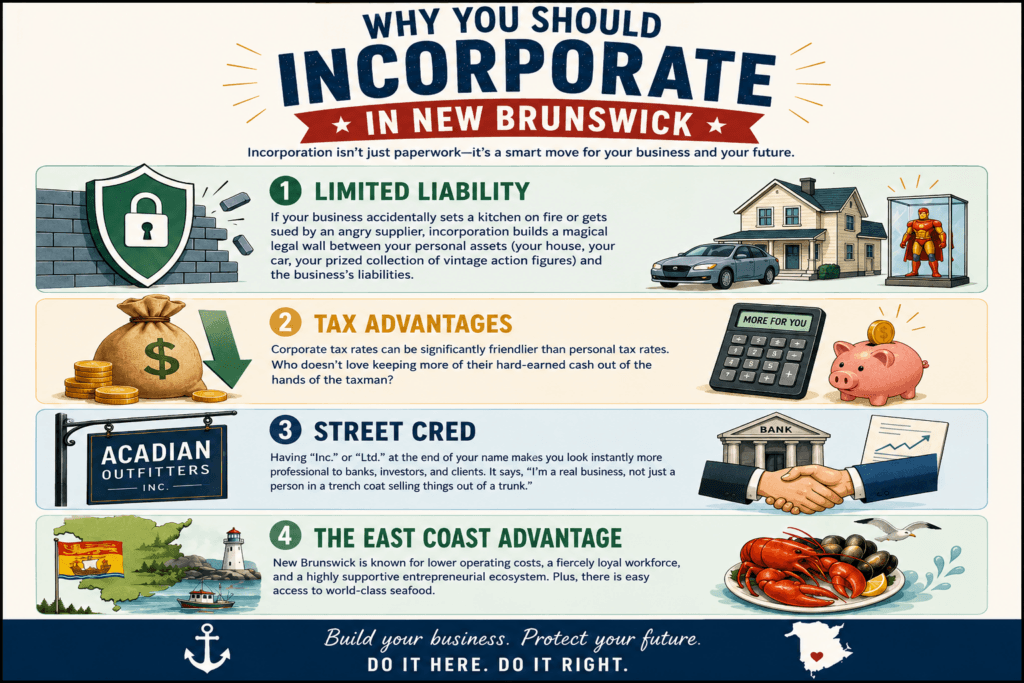
Why You Should incorporate in New Brunswick
Before we dive into the “how,” let’s briefly touch on the “why.” Why go through the hassle of paperwork when you could just operate as a sole proprietorship and call it a day?
- Limited Liability: This is the big one. If your business accidentally sets a kitchen on fire or gets sued by an angry supplier, incorporation builds a magical legal wall between your personal assets (your house, your car, your prized collection of vintage action figures) and the business’s liabilities.
- Tax Advantages: Corporate tax rates can be significantly friendlier than personal tax rates. Who doesn’t love keeping more of their hard-earned cash out of the hands of the taxman?
- Street Cred: Having “Inc.” or “Ltd.” at the end of your name makes you look instantly more professional to banks, investors, and clients. It says, “I’m a real business, not just a person in a trench coat selling things out of a trunk.”
- The East Coast Advantage: New Brunswick is known for lower operating costs, a fiercely loyal workforce, and a highly supportive entrepreneurial ecosystem. Plus, there is easy access to world-class seafood.
The Step-by-Step Guide to New Brunswick Incorporation
Alright, let’s roll up our sleeves. The process of New Brunswick incorporation is managed by Service New Brunswick (SNB), specifically the Corporate Registry. It’s actually one of the more straightforward provincial registries in Canada, but it still requires some strict attention to detail.
Step 1: The Name Game (Choosing Your Corporate Identity)
Every corporation needs a name. You have two choices here, and your decision dictates how much paperwork you have to do today.
The Numbered Corporation
If you don’t care about a fancy corporate name right now, you can opt for a numbered company and incorporate in New Brunswick within hours. SNB will assign you a random string of digits, resulting in a name like 123456 New Brunswick Inc. It’s fast, it’s cheap (no name search required), and it makes you sound like a secret agent. You can always operate your storefront under a different “Trade Name” later.
The Named Corporation
If you absolutely must be Maritime Maple Innovations Inc., you have to prove that no one else is already using that name. This requires ordering a New Brunswick NUANS Report. It’s a specialized search that checks federal and provincial databases for similar trademarks and corporate names.
Pro Tip: Your corporate name must have three elements: a distinctive element (Maritime Maple), a descriptive element (Innovations), and a legal suffix (Inc., Ltd., Corp.). Do not skip the NUANS report – the registry will reject your application faster than a tourist mispronouncing “Kouchibouguac.”
Step 2: The Holy Trinity of Incorporation Forms
To incorporate in New Brunswick and bring your corporate entity into existence, you need to file three specific forms under the New Brunswick Business Corporations Act. Think of these as the birth certificate and DNA profile of your new company.
Form 1 – Articles of Incorporation
This is the big one. The Articles of Incorporation establish the absolute legal structure of your business. You’ll need to declare:
- Your proposed corporate name.
- The province of your registered office.
- Share Structure: This is where you decide how ownership is divided. Will you have just one class of common shares? Or will you have Class A voting shares for the founders and Class B non-voting shares for the wealthy aunt who is funding this endeavour? Keep it simple if you can, but consult an accountant if you are bringing on investors.
- Restrictions on share transfers (usually a requirement if you want to be a private corporation).
Form 2 – Notice of Registered Office
The government needs to know where to send official documents, tax notices, and legal summons. This must be a physical address in New Brunswick. A P.O. Box alone won’t cut it. It’s the official home base of your business.
Form 4 – Notice of Directors
Who is steering this ship? You need to list the full names and residential addresses of the corporation’s initial board of directors to incorporate in New Brunswick. If it’s just you running the show, congratulations: you are the sole director, CEO, and Chief Janitor.
Step 3: Paying the Piper (Submission and Fees)
You’ve got your NUANS report (if named) and your three forms filled out perfectly. Now it’s time to submit them to the Service New Brunswick Corporate Registry online portal.
What’s the damage to your wallet?
- The government fee for incorporating online is $262 (which breaks down to a $250 incorporation fee plus a $12 mandatory fee to publish your new company in the Royal Gazette, which sounds incredibly fancy and Victorian).
- If you went the named route, the NUANS report will cost you around $50 to $75, depending on the search house you use.
Example: How to Incorporate in New Brunswick in Real Life
Let’s make this concrete. Meet our fictional friend, Dave. Dave makes the absolute best lobster rolls in Shediac and wants to turn his secret family recipe into a fast-casual empire. Here is exactly how Dave will incorporate in New Brunswick.
- The Idea: Dave decides his company will be called “Claws & Paws Seafood Ltd.”
- The Search: Dave goes online to a certified search house and orders a New Brunswick NUANS report for “Claws & Paws Seafood.” The report comes back clear—nobody else in the database is using it. (Phew).
- The Paperwork: Dave logs onto the Service New Brunswick Corporate Registry portal.
- He fills out Form 1, setting up a simple share structure of unlimited common shares, and issues 100 shares to himself.
- He fills out Form 2, listing his leased commercial kitchen space in Shediac as the registered office address.
- He fills out Form 4, naming himself as the sole director.
- The Payment: Dave uploads his PDF NUANS report, submits the digital forms, and pays the $262 government fee with his credit card.
- The Result: A few business days later, Dave receives his shiny new Certificate of Incorporation. “Claws & Paws Seafood Ltd.” is officially born. He can now open a corporate bank account, apply for a loan, and start slinging those buttery lobster rolls to the masses.
Post-Incorporation: You’re Not Done Yet!
You popped the champagne, framed your Certificate of Incorporation, and updated your LinkedIn title to “Founder & CEO.” Awesome. But your administrative chores aren’t quite over.
- Set up your Corporate Minute Book: By law, you must maintain a physical or electronic “Minute Book.” This holds your articles, bylaws, director resolutions, share certificates, and ledgers. Do not ignore this. If you ever want a bank loan or an investor, they will ask to see your minute book. If you hand them a shoebox of receipts instead, they will kindly ask you to leave.
- Register with the CRA: Your new corporation is a separate legal “person” and needs its own Social Insurance Number—which for businesses is called a Business Number (BN). You’ll also need to set up a GST/HST account if you expect to gross over $30,000 a year, and a payroll account if you plan to hire employees.
- WorkSafeNB: If you are bringing on a team of employees, you’ll need to register for provincial workers’ compensation insurance.
The “Easy Button” Alternative
Now, if your eyes are already crossing at the thought of digging through government forms and you’d rather stick to perfecting your business pitch, there is an easy out. If you are confused with the paperwork, you can use an incorporation agent like INCORPMASTER CANADA Inc. to incorporate in New Brunswick for you. It’s significantly cheaper than hiring a corporate lawyer to hold your hand, with their New Brunswick incorporation packages starting from 495 CAD. The best part? The filing can be done in just 2 business hours if you are in a rush. That’s right, you could legally incorporate your business from your couch in the time it takes to watch a slightly overlong superhero movie!
Frequently Asked Questions (FAQ)
Do I absolutely need a lawyer to incorporate in New Brunswick?
Legally, no. You can absolutely do it yourself via the Service New Brunswick website if you are comfortable navigating the forms. However, if your business has multiple founders, complex investment structures, or you are deeply allergic to paperwork, paying a corporate lawyer or an incorporation service to do it for you is worth its weight in gold.
Can a non-resident of Canada incorporate a business in New Brunswick?
Yes! Unlike the federal government or certain other provinces, New Brunswick's Business Corporations Act does not currently have a strict Canadian residency requirement for its board of directors. This makes NB an attractive jurisdiction for international entrepreneurs looking for a Canadian home base.
How long does the incorporation process take?
If you incorporate in New Brunswick electronically and your paperwork is flawless, the SNB Corporate Registry typically processes applications within a few business days. If you mail in paper forms, expect to wait a couple of weeks, depending on postal speeds and registry backlogs.
Is my New Brunswick corporation allowed to do business in other provinces?
Your NB corporation is allowed to exist and conduct business nationally, but if you set up a physical office or hire employees in another province (say, Nova Scotia or Alberta), you will likely need to complete an "Extra-Provincial Registration" in that specific province.
What is the deal with the "Royal Gazette"?
It sounds like a newspaper run by the monarchy, right? It's actually just the official provincial government publication where public and legal notices are posted. That $12 portion of your fee covers the mandatory announcement to the world (or at least the three lawyers who read it) that your company now officially exists.
Conclusion
There you have it – the slightly snarky, entirely practical guide to incorporate in New Brunswick. The forms might seem tedious, but remember that every massive, world-changing company started exactly where you are right now: staring blankly at a government PDF.