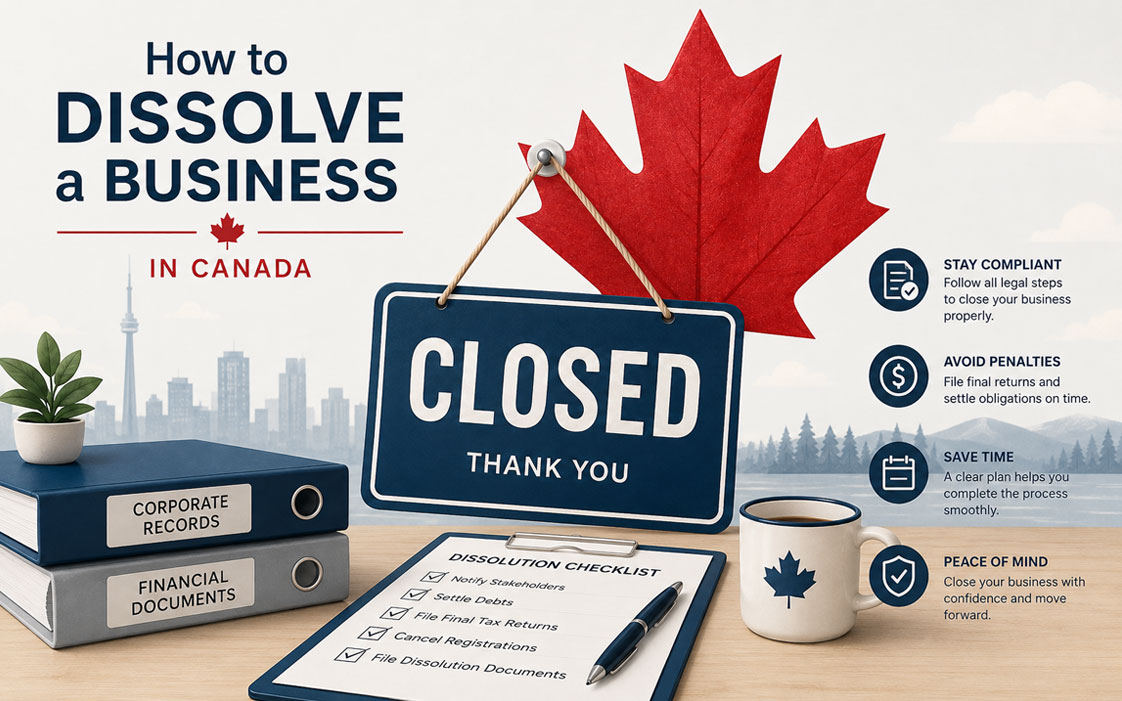
Starting a business takes courage, hard work, and commitment. But sometimes, the right business decision is knowing when it’s time to move on.
Whether your company has fulfilled its purpose, you’re retiring, pursuing a new opportunity, or simply winding down operations, it’s important to understand the proper process to dissolve a business in Canada.
Many business owners assume they can simply stop operating and walk away. Unfortunately, that approach can create future tax issues, government penalties, ongoing filing obligations, and unexpected liabilities.
The good news is that the process doesn’t have to be complicated when you understand the steps involved.
In this guide, we’ll explain how to close a business in Canada, what company dissolution means, common mistakes to avoid, and how IncorpMaster Canada can help make the process easier.
What Does It Mean to Dissolve a Business in Canada?
Business dissolution is the legal process of officially ending a business entity.
Once you shut down a corporation or dissolve another type of business structure, it ceases to exist as a legal entity and is removed from the government registry.
The exact process depends on:
- The type of business
- The province or territory where it was registered
- Whether it was incorporated federally or provincially
- Whether the business has outstanding debts or obligations
Many business owners search for ways to simply stop operating. However, failing to complete a formal company dissolution can leave the business active in government records.
Why Proper Company Dissolution Matters
A formal dissolution helps ensure:
- Government filing obligations end
- Annual return requirements stop
- Corporate liabilities are addressed
- Tax accounts can be closed
- Directors reduce future risks
- Corporate records are properly finalized
Without proper dissolution, a corporation may continue accumulating compliance obligations even if it is no longer operating.
For more information on corporate compliance requirements, see Guide on dissolving a business corporation.
Types of Business Closures in Canada
Sole Proprietorship Closure
A sole proprietorship is generally the easiest business structure to close.
Typically, owners need to:
- Cancel business registrations
- Close CRA accounts
- Pay outstanding taxes
- Notify relevant agencies
Requirements to dissolve a business in Canada vary by province.
Partnership Dissolution
Partnerships require:
- Agreement among partners
- Settlement of business debts
- Distribution of assets
- Cancellation of registrations
A written dissolution agreement is often recommended.
Corporate Dissolution
When you shut down a corporation, additional legal steps are required.
These may include:
- Shareholder approval
- Director resolutions
- Corporate tax filings
- Articles of Dissolution
- Closure of CRA accounts
This process is commonly referred to as company dissolution.
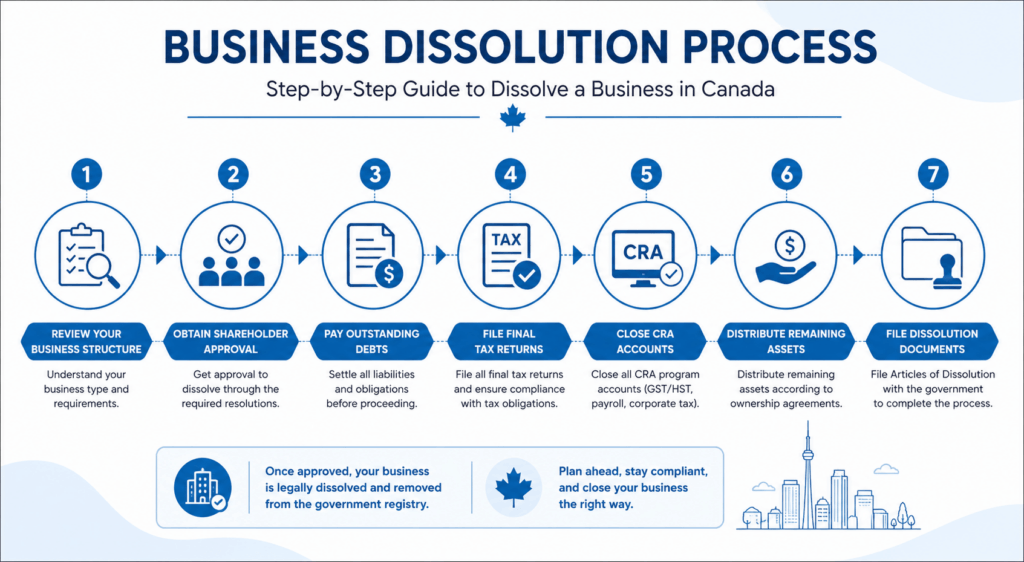
Step-by-Step Guide to Dissolving a Business in Canada
Step 1: Review Your Business Structure
Before beginning the process, confirm whether your business is:
- Sole proprietorship
- General Partnership
- Provincial corporation
- Federal corporation
The dissolution process varies depending on the structure.
Step 2: Obtain Shareholder Approval
For corporations, shareholders generally must approve the decision to dissolve a business in Canada.
This approval is usually documented through:
- Shareholder resolutions
- Special resolutions
- Meeting minutes
Maintaining proper records helps demonstrate compliance.
Step 3: Pay Outstanding Debts
Before proceeding with company dissolution, settle any outstanding obligations such as:
- Supplier invoices
- Loans
- Employee wages
- Lease obligations
- Tax liabilities
Creditors should be paid before distributing remaining corporate assets.
Step 4: File Final Tax Returns
One of the most important steps when you close a business in Canada is completing final tax filings.
Depending on the business structure, this may include:
- Corporate income tax returns
- GST/HST returns
- Payroll remittances
- Provincial tax obligations
Consulting a tax professional is often beneficial when you decide to dissolve a business in Canada.
Step 5: Close CRA Program Accounts
Businesses commonly maintain accounts such as:
- GST/HST
- Payroll
- Import/export
- Corporate tax accounts
These accounts should be properly closed after all filings are completed.
For guidance on maintaining business compliance, visit the Canada Revenue Agency website.
Step 6: Distribute Remaining Assets
After debts have been paid, remaining assets can be distributed according to:
- Share ownership
- Partnership agreements
- Corporate resolutions
Proper documentation should be maintained for future reference.
Step 7: File Dissolution Documents
The final legal step is filing the required dissolution documents.
Depending on the jurisdiction, this may include:
Federal Corporations
Typically require:
- Articles of Dissolution
- Supporting resolutions
- Government filing fees
Provincial Corporations
Requirements vary by province.
Common filings may include:
- Articles of Dissolution
- Requests for cancellation
- Supporting corporate documents
Once approved, the corporation is formally dissolved.
Common Reasons Businesses Choose Dissolution
Business owners dissolve corporations for many reasons.
Retirement
Many entrepreneurs close their businesses after years of successful operation.
Business No Longer Active
Some companies remain inactive for years before owners decide to complete formal dissolution.
Corporate Restructuring
Business owners may dissolve one corporation while launching another.
Sale of Assets
After selling assets or operations, dissolution may be the final step.
Cost Reduction
Maintaining inactive corporations can create ongoing compliance costs.
Common Mistakes When Closing a Business
Ignoring Annual Filings
Many owners stop operating but continue receiving compliance obligations.
The corporation remains active until officially dissolved.
Forgetting Tax Accounts
Unclosed CRA accounts can create confusion and future issues.
Distributing Assets Too Early
Assets should generally not be distributed until debts are addressed.
Missing Corporate Records
Proper documentation remains important even during dissolution.
Assuming Inactivity Equals Closure
Simply stopping business activity does not legally dissolve a corporation.
Myth vs Fact: Dissolving a Business in Canada
Myth: If I stop operating, my company automatically closes.
Fact: Most corporations remain active until formal dissolution documents are filed.
Myth: Dissolution eliminates unpaid debts.
Fact: Outstanding obligations generally survive dissolution and may create complications.
Myth: Dissolution is only for failing businesses.
Fact: Many successful entrepreneurs dissolve businesses after retirement, restructuring, or completing specific projects.
Myth: Corporate records are no longer needed.
Fact: Business records often need to be retained for legal and tax purposes.
Pro Tips for a Smooth Company Dissolution
Keep Detailed Records
Store all resolutions, tax filings, and dissolution documents securely.
Plan Ahead
Start preparing several months before your desired closure date.
Resolve Tax Matters Early
Tax issues are often the biggest source of delays.
Communicate with Stakeholders
Notify employees, customers, suppliers, and service providers.
Get Professional Assistance
Professional guidance can help avoid costly errors.
When Should You Seek Professional Help?
Business dissolution can become more complex when:
- Multiple shareholders are involved
- Significant assets exist
- Tax liabilities remain outstanding
- Cross-provincial registrations exist
- The corporation has operated for many years
Professional assistance can help ensure all requirements are completed correctly.
IncorpMaster Canada helps business owners navigate corporate filings and administrative requirements when you need to dissolve a business in Canada.
Frequently Asked Questions
How long does it take to dissolve a business in Canada?
Timelines vary depending on the jurisdiction, complexity of the corporation, and whether tax obligations have been resolved.
Can I dissolve a corporation with no business activity?
Yes. Many inactive corporations are dissolved after owners decide they are no longer needed.
Do I need shareholder approval?
In most corporate dissolutions, shareholder approval is required.
What happens if I don't dissolve my corporation?
The corporation may continue to have annual filing and compliance obligations.
Can I reopen a dissolved corporation?
In some circumstances, revival may be possible depending on the jurisdiction and applicable rules.
Is dissolution the same as bankruptcy?
No, Bankruptcy addresses insolvency, while dissolution is the legal termination of a business entity.
Final Thoughts: Close Your Business the Right Way
Choosing to dissolve a business in Canada is an important business decision. Whether you’re retiring, restructuring, or simply moving on to your next venture, taking the proper legal steps can help you avoid future complications.
A formal company dissolution ensures that your corporation’s affairs are properly concluded and that government records accurately reflect its status.
If you’re ready to shut down a corporation or close a business in Canada, professional guidance can make the process significantly easier.
IncorpMaster Canada assists Canadian business owners with corporate filings and business lifecycle services, helping ensure important administrative requirements are handled correctly.
Ready to take the next step? Contact IncorpMaster Canada today to learn more about your dissolution options and begin the process with confidence.