Let’s be honest. When you hear the words “incorporation,” “government paperwork,” and “legal compliance,” your eyes probably glaze over faster than a bounce rate on a website that still uses Comic Sans.
But you’re an SEO professional, a digital marketer, or a benevolent nerd with a heart of gold. You spend your days analyzing search intent, building backlinks, and trying to appease the almighty Google algorithm. Now, you’ve decided to use your powers for good. You want to incorporate a non-profit. Maybe you want to teach underprivileged kids how to code, or perhaps you want to save endangered digital marketing tactics from extinction.
Whatever your noble cause, incorporating a non-profit in Canada is a lot like SEO: it takes time, the rules occasionally change, and if you do it wrong, you’ll find yourself in a bureaucratic sandbox.
Grab a cup of coffee (or a stiff drink, we don’t judge), and let’s dive into this comprehensive, mildly sarcastic, and highly actionable guide to making your do-gooder dreams a reality.
Why Incorporate a Non-Profit? (And Not Just Run a Really Nice Hobby)
Before we get into the nitty-gritty of non profit organization registration, we need to ask: why bother? Why not just collect donations in a shoebox and do good deeds on the weekends?
The “White Hat” Benefits
In the SEO world, we love “White Hat” tactics – doing things by the book to build long-term authority. Incorporating your non-profit is the ultimate White Hat move.
- Limited Liability: Just like a firewall protects your server, incorporation protects your personal assets. If your non-profit gets sued because someone tripped at your annual “Optimize Your Life”
- Credibility: A registered corporation looks official. It’s the real-world equivalent of having a Domain Authority of 80. People, sponsors, and the government take you more seriously.
- Perpetual Existence: Your non-profit can live on forever, outlasting its founders. It’s the ultimate evergreen content!
The “Algorithm Updates” (A.k.a. The Downsides)
It’s not all sunshine and organic traffic. There are administrative burdens. You have to hold annual meetings, keep immaculate records, and file annual returns. It’s basically like doing a technical SEO audit every single year, but for the government.
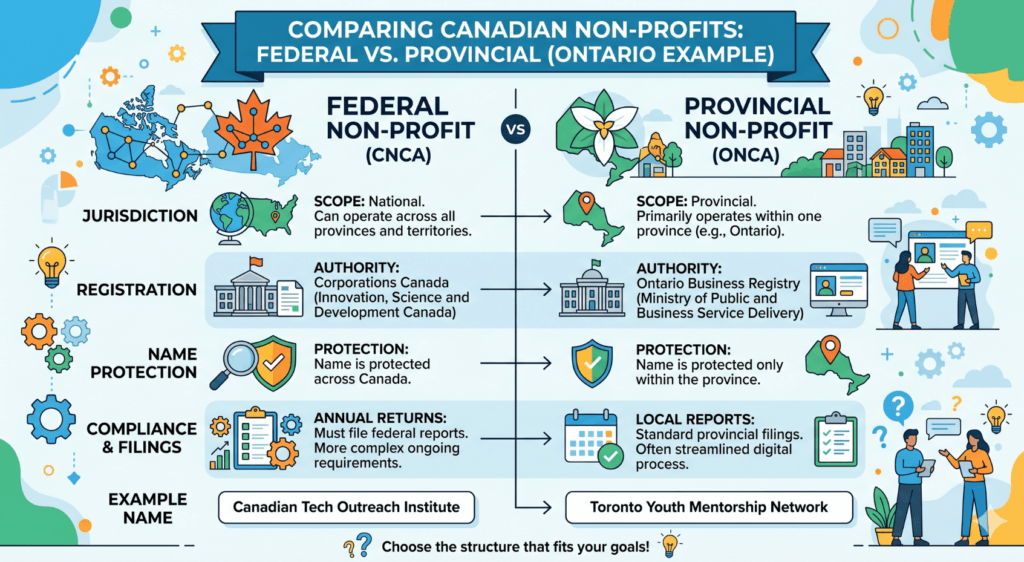
Federal vs. Provincial: Choosing Your Server Location
In Canada, you have a massive choice to make right out of the gate. Do you incorporate a non-profit federally or provincially?
Going Federal (The .COM approach)
Incorporating federally means you are registered under the Canada Not-for-profit Corporations Act (CNCA).
- Pros: You get to use your shiny new organization name anywhere in Canada. It carries prestige, much like having a highly coveted .com domain.
- Cons: It’s a bit more rigorous. Plus, if you plan to operate in specific provinces, you still have to register extra-provincially there anyway. Bureaucracy, yay!
Going Provincial (The .CA approach)
If you only plan to do your good deeds in one province, you can incorporate a non-profit provincially. Since we know a lot of our SEO audience is clustered around the tech hubs, we are going to focus heavily on Ontario for this guide.
If you are looking specifically into non-profit organization registration in ontario, you’ll be dealing with the Ontario Not-for-Profit Corporations Act (ONCA). It’s perfect if your activities are hyper-localized – like a local SEO campaign!
Step-by-Step Guide to Navigating the Bureaucracy
Alright, let’s get our hands dirty. Here is the step-by-step process that will make the registration of non profit organization feel less like a root canal and more like a satisfying spreadsheet deduplication.
Step 1: Keyword Research… Wait, We Mean “Name Search”
You can’t just call your non-profit “The Good Guys” and call it a day. The government is very picky about names. Your name needs to be distinctive, indicate your activity, and not be confused with existing organizations.
You will need to request a NUANS (Newly Upgraded Automated Name Search) report. Think of this as using Ahrefs or SEMrush to check keyword competition, but for your legal name. If someone else is already ranking for your exact match name, you have to pivot.
Step 2: Drafting Your Articles of Incorporation
Your Articles of Incorporation are the foundational code of your organization. It’s the HTML skeleton upon which your CSS (your mission) will be applied.
You’ll need to declare:
- Your shiny new, government-approved name.
- Your registered office address.
- The minimum and maximum number of directors.
- Your statement of purpose (What exactly are you doing? e.g., “Providing free SEO audits for animal shelters”).
- Provisions regarding the distribution of property upon dissolution (If the non-profit dies, where does the money go? Spoiler: Not your pocket).
Step 3: Assembling Your Backlink Profile… Er, Board of Directors
You can’t do this alone. To incorporate a non-profit, you need a Board of Directors. For a federal non-profit, you need at least three directors, and at least two of them cannot be officers or employees of the corporation.
Choose wise, reliable people. These are the high-quality, high-DR backlinks pointing to your organization, vouching for its legitimacy and guiding its strategy.
What makes a good director?
- Someone who actually answers emails.
- Someone who understands governance.
- Someone who doesn’t fall asleep during meetings about bylaws.
Step 4: Pressing “Publish” (Filing the Paperwork)
Once you have your NUANS report, your Articles of Incorporation, and your brave directors, it’s time to submit.
You’ll take all these documents, pay the filing fee (usually around $200 CAD federally, or slightly different provincially), and submit them to Corporations Canada or your provincial registry. Once approved, you’ll receive your Certificate of Incorporation. Congratulations, you are officially indexed!
Zooming In: The Ontario Landscape
For our friends in the six, Ottawa, and beyond, let’s get hyper-specific.
Wait, how to incorporate a non-profit organization in Ontario?
Glad you asked! Ontario recently updated its laws with the ONCA (Ontario Not-for-Profit Corporations Act), finally dragging the province out of 1990s legislation and into the modern era.
To register in Ontario, you will use the Ontario Business Registry. The process is entirely online now (praise the tech gods!). You log in, fill out the forms using your One-key ID (Ontario’s version of a two-factor authentication login), pay the $155 provincial fee, and submit. The system is actually surprisingly user-friendly – at least compared to trying to explain core web vitals to a boomer client.
A Real-Life Example: “Grandmas Who Rank”
Let’s put all this theory into practice. Let’s say you, a seasoned SEO specialist, want to start an organization that teaches elderly individuals how to build and optimize their own blogs to share their recipes, knitting patterns, and unfiltered opinions on modern youth.
Let’s call it “Grandmas Who Rank.”
- The Name: You run a NUANS search. Good news! Nobody has claimed “Grandmas Who Rank.” (Shocking, we know).
- The Choice: Because you want to eventually launch chapters from Vancouver to Halifax, you decide to incorporate federally.
- The Directors: You recruit your former agency boss (who owes you a favor), your tech-savvy Aunt Mildred, and a local community center manager.
- The Purpose: In your Articles of Incorporation, you state: “To provide digital literacy, specifically search engine optimization education, to senior citizens across Canada to combat isolation and foster digital community engagement.”
- The Filing: You submit the paperwork online to Corporations Canada, pay the $200 fee, and wait.
- The Result: Two weeks later, a shiny Certificate of Incorporation arrives in your inbox. “Grandmas Who Rank” is officially born! Next stop: applying for registered charity status so people can get tax receipts when they donate server space for Aunt Mildred’s aggressive backlinking campaigns.
The Next Steps: Don’t Get De-Indexed
Incorporating is just step one. Once you are incorporated, you have to hold an “organizational meeting” to officially adopt your bylaws, appoint officers (President, Secretary, Treasurer), and set up a bank account.
And remember, just because you are a non-profit doesn’t mean you are a registered charity. That’s a whole different, much more intense application process with the Canada Revenue Agency (CRA). Think of incorporation as getting your website live, and getting charitable status as earning the coveted Google Knowledge Panel.
Frequently Asked Questions (FAQ)
Is a Non-Profit the same thing as a Registered Charity?
No. This is the biggest misconception out there. A non-profit organization (NPO) can operate to achieve a social, recreational, or philanthropic purpose, and it doesn't pay income tax. However, it cannot issue official donation receipts for tax purposes.
A Registered Charity has gone through a rigorous secondary approval process with the Canada Revenue Agency (CRA). Only registered charities can issue tax receipts to donors. Every registered charity is a non-profit, but not every non-profit is a registered charity. (It's like how every square is a rectangle, but not every rectangle is a square).
Do I really need a lawyer to incorporate a non-profit?
Legally? No. You can absolutely DIY this, especially with the streamlined online portals. The federal government and the Ontario government provide template bylaws that you can use.
However, if your non-profit has a highly complex structure, or if you are dealing with significant assets, liability risks, or complicated charitable purposes, hiring a lawyer is highly recommended. It’s like doing your own SEO - you can do it yourself, but sometimes hiring a technical expert saves you from a massive penalty down the road.
How much does it cost?
If you incorporate a non-profit yourself without legal fees:
- Federal Incorporation: $200 CAD if done online.
- NUANS Report: Typically around $15 to $30 CAD.
- Ontario Provincial Incorporation: $155 CAD.
If you hire a lawyer or a service to do it for you, expect to pay anywhere from $1,000 to $3,000+, depending on the complexity of your bylaws.How long does the process take?
If you file your paperwork online and your articles are standard (using the provided templates), the government can process your incorporation in as little as 1 to 5 business days. Bureaucracy moves surprisingly fast when it's digitized!
Can founders be paid a salary?
Yes, but there are strict rules. In a non-profit, founders can be employees and draw a reasonable salary for the work they do. However, they cannot simply distribute "profits" to themselves like a regular business dividend. If you go on to apply for charitable status, the rules get even stricter: directors of charities generally cannot be paid for their role as directors. Always consult an accountant before cutting yourself a check.
Conclusion
Starting a non-profit in Canada is a noble endeavour that requires patience, attention to detail, and a healthy tolerance for PDF forms. But by following the right steps – conducting your name search, organizing your board, and navigating the federal or provincial portals – you can build an organization that creates a lasting, positive impact on society.