
Running a business in Canada can feel like a rollercoaster. One minute you’re celebrating your first client payment, and the next minute you’re wondering why printer ink costs more than gold.
The good news? Many of those business costs may actually reduce your taxes.
If you’ve ever Googled “How to write off business expenses”, stared at a pile of receipts, and whispered “please help,” this guide is for you.
Whether you operate an Ontario sole proprietorship, freelance from your kitchen table, or run a growing company, understanding deductible expenses can save you thousands of dollars every year.
In this guide, we’ll break down:
- What business write-offs actually mean
- Common deductible expenses in Canada
- CRA rules you need to know
- Examples for Ontario self-employed individuals
- Mistakes to avoid
- FAQs for small business owners
Let’s make taxes slightly less terrifying.
What Does “Writing Off Business Expenses” Actually Mean?
A business expense write-off is simply a cost you subtract from your business income to reduce the amount of tax you owe.
Example:
- You earned: $80,000
- You spent: $20,000 on legitimate business expenses
- Taxable business income: $60,000
That means the CRA taxes you on the lower amount.
Pretty nice, right?
This is why understanding how to write off business expenses from your Ontario sole proprietorship is essential for every entrepreneur.
What Counts as a Tax-Deductible Business Expense?
The CRA allows you to deduct expenses that are:
- Reasonable
- Necessary for earning business income
- Properly documented
In simple terms:
If you bought something because it genuinely helps your Ontario sole proprietorship operate, market, sell, or function, there’s a good chance it may qualify.
Many entrepreneurs search for tax-deductible business expenses because the rules can feel confusing at first.
Don’t worry – you don’t need to become an accountant overnight.
Common Business Write-Offs in Canada
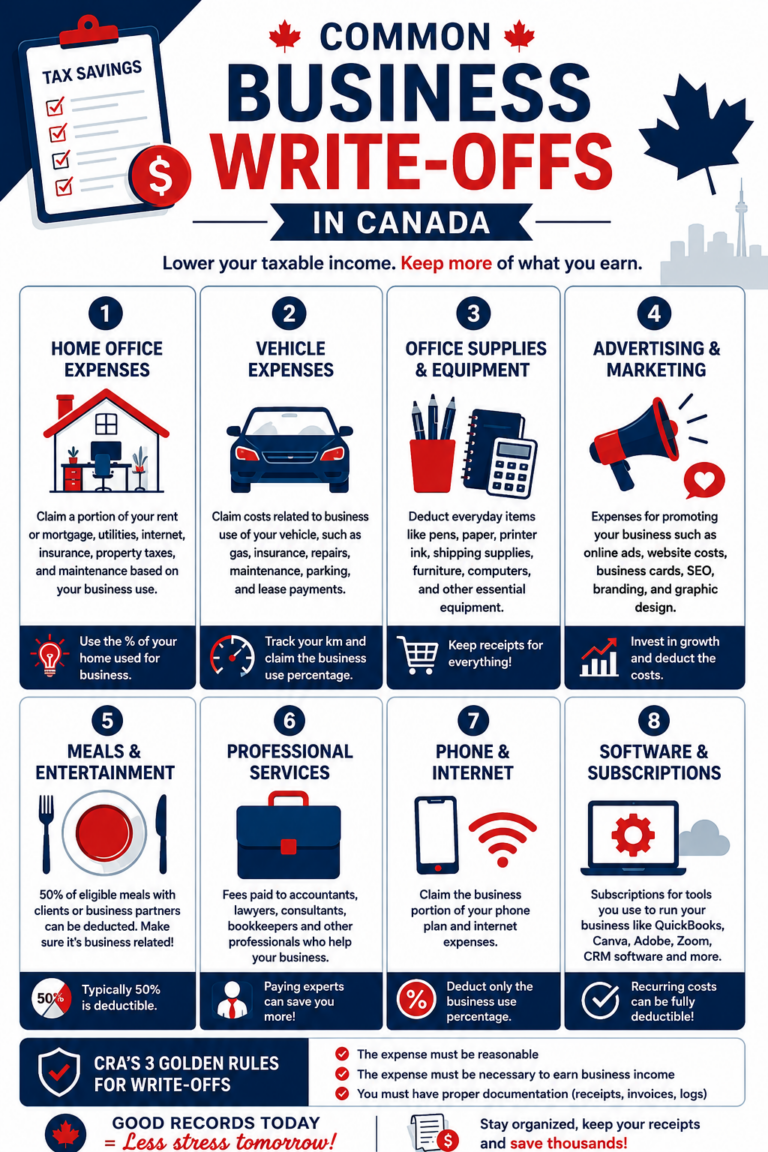
Home Office Expenses
If you work from home, congratulations: your kitchen table may now be partially tax-deductible.
You may be able to claim:
- Rent
- Utilities
- Internet
- Property taxes
- Home insurance
- Mortgage interest (in some cases)
- Maintenance and repairs
The key is calculating the percentage used for business.
Example
Your home office takes up 15% of your home.
You may claim roughly 15% of eligible household expenses.
That suddenly makes your Wi-Fi bill feel a little more exciting.
Vehicle Expenses
If you use your car for business purposes, part of your vehicle costs may qualify.
Possible deductions include:
- Gas
- Insurance
- Repairs
- Maintenance
- Registration fees
- Lease payments
- Parking
- Car washes
- Interest on car loans
But here’s the important part:
You can only deduct the business-use portion.
So if you drove:
- 20,000 km total
- 8,000 km for business
You may claim 40% of eligible vehicle expenses.
The CRA loves mileage logs almost as much as coffee shops love charging $8 for oat milk lattes.
Office Supplies
This category includes everyday business essentials such as:
- Pens
- Printer paper
- Ink
- Shipping supplies
- Sticky notes you swear make you more productive
These smaller expenses add up fast when you open an Ontario sole proprietorship.
Advertising and Marketing
Good news for anyone spending money on growth.
You may deduct:
- Facebook ads
- Google ads
- Website costs
- Business cards
- SEO services
- Graphic design
- Marketing software
This is one reason many entrepreneurs researching business write offs in Canada are surprised by how many digital expenses qualify.
Meals and Entertainment
Yes, your business lunch may qualify.
But before you start claiming every pizza night as “strategic planning,” here’s the catch:
Typically, only 50% of meal and entertainment expenses are deductible.
The expense must also be business-related.
Examples:
- Meeting a client for coffee
- Taking a business partner to lunch
- Discussing work over dinner
No, “thinking about business while eating tacos alone” usually doesn’t count.
Professional Services
You may deduct fees paid to:
- Accountants
- Lawyers
- Consultants
- Bookkeepers
- Tax professionals
Honestly, paying an accountant to help you save money on your Ontario sole proprietorship taxes feels like the most Canadian business loophole ever.
Phone and Internet
If you use your phone and internet for work, the business-use percentage may qualify.
Example:
- 70% work use
- 30% personal use
You may deduct 70% of eligible costs.
Software and Subscriptions
Modern businesses run on subscriptions.
You may be able to deduct:
- Canva
- Adobe
- Zoom
- QuickBooks
- CRM software
- Email marketing tools
- Cloud storage
At this point, half of entrepreneurship is just remembering which subscriptions are auto-renewing.
Example: Writing Off Business Expenses as a Self-Employed Person in Ontario
Let’s look at a realistic example.
Sarah the Freelance Graphic Designer
Sarah operates an Ontario sole proprietorship in Toronto.
She earns:
- $75,000 annually from clients
Her business expenses include:
| Expense | Amount |
|---|---|
| Home office | $3,000 |
| Internet & phone | $1,200 |
| Laptop | $2,000 |
| Adobe subscription | $500 |
| Advertising | $2,500 |
| Vehicle expenses | $3,000 |
| Meals with clients | $800 |
| Accountant fees | $600 |
| Total | $13,600 |
Total deductible expenses:
Approximately $13,600
Her taxable business income becomes:
- $61,400 instead of $75,000
That difference can significantly reduce taxes owed.
This is exactly why understanding tax write-offs for small business canada matters so much.
What the CRA Usually Wants From You
The CRA isn’t trying to ruin your life.
They just want proof.
Keep These Records
Receipts
Always keep:
- Digital receipts
- Invoices
- Bank statements
- Credit card records
Mileage Logs
Track:
- Date
- Destination
- Purpose
- Kilometers driven
Business Purpose
If an expense looks questionable, document why it was business-related.
Example:
“Client strategy lunch”
sounds much better than
“burger craving emergency.”
Expenses You Usually Cannot Claim
Sadly, not everything qualifies.
Personal Expenses
You generally cannot deduct:
- Personal groceries
- Family vacations
- Netflix for “research.”
- Designer sunglasses because of an “entrepreneur mindset.”
The CRA has heard every creative excuse imaginable.
Excessive Expenses
Even if something is business-related, it must still be reasonable. Buying a gold-plated office chair for your Ontario sole proprietorship probably won’t impress the CRA.
Best Practices for Tracking Business Expenses
Open a Separate Business Bank Account
This makes bookkeeping dramatically easier. Mixing personal and business spending creates chaos faster than a toddler with permanent markers.
Use Accounting Software
Popular options include:
- QuickBooks
- Wave
- FreshBooks
- Xero
These tools simplify expense tracking and tax preparation.
Save Receipts Digitally
Paper receipts have a magical ability to disappear exactly when needed.
Use:
- Cloud storage
- Receipt scanning apps
- Accounting software uploads
Future-you will be grateful.
What Can You Claim on Your Taxes in Ontario?
Many business owners ask:
what can you claim on your taxes of Ontario sole proprietorship
The answer depends on:
- Your business structure
- Your industry
- Your actual business activities
However, most Ontario small businesses commonly claim:
- Home office expenses
- Marketing costs
- Vehicle expenses
- Equipment
- Internet and phone
- Software
- Professional services
- Office supplies
The key is ensuring the expense is genuinely connected to earning business income.
CRA Business Expenses List You Should Know
The CRA provides extensive guidance regarding deductible expenses of Ontario sole proprietorships and Ontario corporations.
Many entrepreneurs search for a complete business expenses list cra to understand what qualifies.
Some major categories include:
Operating Expenses
- Rent
- Utilities
- Insurance
- Salaries
Capital Expenses
- Equipment
- Computers
- Furniture
Vehicle Expenses
- Fuel
- Maintenance
- Insurance
Marketing Expenses
- Ads
- Website development
- Branding
Professional Fees
- Accounting
- Legal services
Sole Proprietorship vs Incorporation for Tax Write-Offs
Whether you’re incorporated or operating as a sole proprietor, many deductions remain similar.
However, incorporation may provide:
- Additional tax planning opportunities
- Liability protection
- Income flexibility
Many entrepreneurs start with an Ontario sole proprietorship before transitioning into a corporation later. If you don’t know the difference between an incorporated and an unincorporated business, please check this article about an Ontario sole proprietorship vs an Ontario corporation.
Biggest Mistakes Small Business Owners Make
Not Tracking Expenses
This is the classic mistake. If you don’t track it, you probably can’t claim it.
Throwing Away Receipts
The CRA may request documentation years later. Keep records organized.
Claiming Personal Expenses
Trying to claim your dog as “Head of Security” is probably not going to work.
Waiting Until Tax Season
Bookkeeping becomes much easier when done monthly instead of during one caffeine-fueled panic session in April.
Register as Self-employed with IncorpMaster Canada
Starting a business in Ontario? IncorpMaster Canada can help simplify the process from day one. Whether you need to register an Ontario Sole Proprietorship or set up essential CRA program accounts, their team can assist you quickly and professionally. This includes registering your HST/GST account, payroll account, and corporate tax account so your business is ready to operate properly and stay compliant with CRA requirements. Instead of dealing with confusing paperwork and government forms alone, entrepreneurs can save time and focus on growing their business while IncorpMaster Canada handles the registration process behind the scenes.
Final Thoughts
Learning how to manage business expenses is one of the smartest financial skills a Canadian entrepreneur can develop.
Understanding:
- deductible expenses,
- CRA rules,
- proper bookkeeping,
- and legitimate write-offs
can potentially save your Ontario sole proprietorship thousands every year. The goal isn’t to avoid taxes illegally. The goal is simply to avoid paying more tax than necessary.
And honestly?
If you’re already spending money to run your Ontario business, you deserve to understand how those expenses work for you.
Frequently Asked Questions
1) What are the most common tax write-offs for small businesses in Canada?
Some of the most common deductions include:
- Home office expenses
- Vehicle expenses
- Internet and phone
- Advertising
- Office supplies
- Software subscriptions
- Professional fees
2) Can I write off my internet bill?
Yes, if part of your internet use is business-related. Only the business-use percentage is deductible.
3) Can self-employed people write off meals?
Usually, yes, but typically only 50% of eligible business meals can be claimed.
4) How long should I keep receipts in Canada?
The CRA generally recommends keeping records for at least six years.
5) Can I write off my laptop?
Yes, computers and laptops used for business purposes may qualify as deductible business expenses or capital assets.
6) Do I need a registered business to claim expenses?
Not always. Even freelancers and self-employed individuals can claim legitimate business expenses if they earn business income.
7) Can I claim home office expenses as a sole proprietor in Ontario?
Yes, many self-employed individuals operating an Ontario sole proprietorship may qualify to claim a portion of household expenses related to business use.