Ah, Quebec. Home to world-class festivals, the best maple syrup on the planet, winters that build serious character, and a thriving, vibrant entrepreneurial ecosystem. If you are reading this, you are probably sitting at your kitchen table, a half-empty mug of coffee in hand, dreaming about finally being your own boss. You’ve got a brilliant idea, a burning passion, and the sudden, terrifying realization that operating as a sole proprietor is a bit like riding a unicycle on the Autoroute – technically possible, but incredibly risky.
You need the glorious shield of limited liability. You need a corporation.
But navigating government bureaucracy is usually as enjoyable as a surprise root canal. Fear not! We are going to demystify the entire process. By the end of this guide, you’ll know exactly how to incorporate in Quebec without pulling your hair out. Grab a fresh coffee, maybe a croissant, and let’s dive into the wild world of business registration.
Welcome to Belle Province: Why Incorporate in Quebec?
Before we get into the paperwork, let’s talk about the “why.” Quebec is a massive hub for innovation. The province boasts competitive corporate tax rates (a sweet combined federal and provincial rate of 12.2% on your first $500,000 of active business income), a highly educated bilingual workforce, and plenty of government grants for startups.
If you want to start a business in Quebec, you are in fantastic company. But what should you actually do?
The Most Profitable Business Ideas in Quebec Right Now
If you are still brainstorming, here are a few niche markets and business models that are practically printing money in Quebec right now:
- AI Consulting and Tech Startups: Quebec (especially Montreal) is a global powerhouse for Artificial Intelligence. Businesses helping other local companies automate their workflows or implement AI solutions are booming.
- Eco-Friendly E-Commerce: Quebecers are highly environmentally conscious. Dropshipping or manufacturing zero-waste products, biodegradable home goods, or sustainable fashion is a massive growth sector.
- Virtual Assistant Services: With the permanent shift to remote work, businesses desperately need administrative help, inbox management, and social media scheduling (not an agency, just freelance assistance!).
- Specialized Home Services: Think solar panel cleaning, smart-home installations, or energy-efficiency consulting. Thanks to provincial green energy rebates, homeowners are throwing money at these services.
The Million Dollar Question: Provincial or Federal?
When you decide to take the plunge, you face your first major fork in the road: do you incorporate in Quebec provincially or federally?
Going Provincial (LSAQ)
When you incorporate in Quebecprovincially under the Loi sur les sociétés par actions (LSAQ), your company is born in Quebec.
- The Pros: It’s straightforward, it’s cheaper if you only plan to operate in Quebec, and there are absolutely no requirements regarding the residency or citizenship of your directors.
- The Cons: Your business name is only protected within the borders of Quebec. If someone in Alberta wants to use your exact name, they can.
Going Federal (CBCA)
If you incorporate in Quebec federally under the Canada Business Corporations Act (CBCA), your company is a Canadian citizen with the right to do business anywhere in the country.
- The Pros: Nationwide name protection. It looks a bit more prestigious if you plan to pitch to international investors.
- The Cons: You still have to register your federal company in Quebec (which means paying both federal and provincial fees). Furthermore, at least 25% of your board of directors must be resident Canadians.
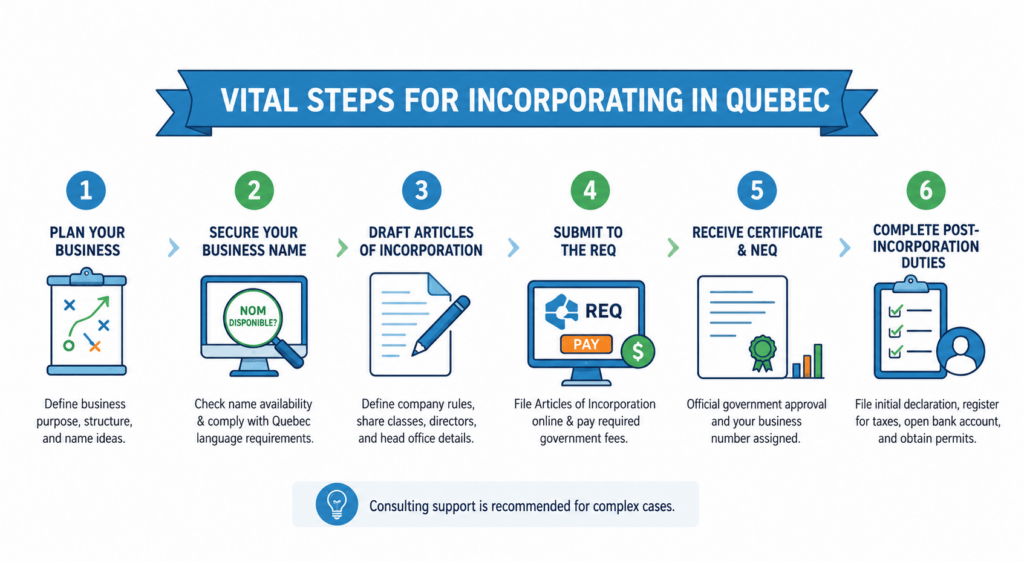
How to Incorporate in Quebec? (Your Step-by-Step Playbook)
Alright, roll up your sleeves. Here is the exact path to getting your business off the ground, focusing on the provincial route.
Step 1: Naming Your Brainchild (And Following the Rules)
Choosing a name is the fun part, right? Well, yes, until you realize the name “Super Awesome Tech Guys Inc.” might not fly with the provincial government. Your corporate name needs three elements: a distinctive element (the unique part), a descriptive element (what you do), and a legal element (Inc., Corp., Ltd.).
The French Connection
Here is the most critical rule in Quebec: thanks to the Charte de la langue française (and the recent Bill 96 updates), your company must have a French name.
Does this mean you can’t use English? No! You can have an English version of your name, but the French version must be the primary one used in the province, or at the very least, your English name needs a French generic descriptor attached to it when doing business here.
Step 2: Choosing Your Corporate Structure
You need to figure out your share structure. Who gets voting shares? Who gets non-voting dividend shares? If you are a solo founder, you can usually keep it simple: 100% of the voting shares go to you.
Step 3: Filing the Paperwork with the REQ
The Registraire des entreprises du Québec (REQ) is the ultimate gatekeeper of your entrepreneurial dreams. You will need to go to the REQ website and submit your Articles of Incorporation (Statuts de constitution).
The Initial Declaration
Within 60 days of your incorporation being approved, you absolutely must file an Initial Declaration. This tells the government who the directors are, who the major shareholders are, and where your head office is located. Do not forget this step, or the government will send you angry letters, and nobody likes angry government letters.
Let’s Talk Money: How much does it cost to incorporate in Quebec?
Ah, the budget. Every entrepreneur’s favorite spreadsheet. So, how much does it cost to incorporate in Quebec in 2026?
The Bare Minimum vs. The Real World
If you are a hardcore DIYer and you do everything yourself via the REQ portal, the base provincial government filing fee is $367 CAD.
However, doing it perfectly on your own is rare. Here is the real-world breakdown of what you should expect to spend:
- Government Filing Fee (Provincial): $367
- Name Reservation/Search (Optional but recommended): ~$25 to $50
- Corporate Minute Book: $150 to $350. (Yes, you legally need a physical or digital binder containing your bylaws, share certificates, and director resolutions).
- Professional Fees (Lawyer/Notary/Accountant): $800 to $1,500.
You can reduce legal expenses by using a professional incorporation intermediary such as Incorpmaster Canada. Quebec corporation packages start at just CAD $495. A professional filing agent will handle the incorporation paperwork on your behalf, making the process simple and hassle-free.
A Real-World Example: Lucie’s Sustainable Empire
To make this crystal clear, let’s look at a hypothetical example.
Meet Lucie. Lucie lives in Montreal and makes incredible, eco-friendly, biodegradable lunchboxes. Her friends love them, her family loves them, and she’s ready to take over the world. She decides to incorporate in Quebec.
How Lucie Managed to Incorporate in Quebec Without Losing Her Mind
- The Name: Lucie wanted to call her company “Green Box Inc.” Because she is in Quebec, she registered the French primary name as Les Boîtes Vertes de Lucie Inc., with “Green Box Inc.” as the English version.
- The Filing: She went to the REQ website, paid her $367 fee, and filed her Articles of Incorporation online.
- The Aftermath: Three days later, the government emailed her a certificate. She was officially a CEO! She then spent $200 on a digital Minute Book service to generate her bylaws and issue herself 100 Class A voting shares.
- The Growth: Because she incorporated provincially, she enjoyed a super-low corporate tax rate, reinvested her profits, and eventually started selling her lunchboxes across Canada.
The “What’s Next?” Checklist
You have your certificate. You popped a bottle of cheap champagne. Now what?
Get Your NEQ
When you incorporate in Quebec, you are automatically assigned a Numéro d’entreprise du Québec (NEQ). This 10-digit number is basically your company’s social insurance number. You will need it for everything: taxes, permits, and banking. Memorize it, or at least put it on a sticky note.
Open a Business Bank Account
Do not, under any circumstances, mix your personal grocery money with your corporate funds. The corporate veil only protects you if you treat the corporation like a separate legal entity. Take your Articles of Incorporation and your NEQ to your local bank (or an online business bank) after you incorporate in Quebec and open a dedicated corporate checking account.
Register for QST and GST
If your worldwide taxable sales exceed $30,000 in a calendar quarter or over the last four consecutive quarters, you are legally required to register for the GST (Goods and Services Tax) and the QST (Quebec Sales Tax). Even if you haven’t hit $30,000 yet, it’s often smart to register voluntarily right away so you can claim input tax credits on your startup expenses!
Frequently Asked Questions (FAQ)
Do I really need a lawyer to figure out how to incorporate in Quebec?
Need? No. The REQ portal allows anyone to file their own paperwork. However, if you are bringing on investors, have multiple founders, or need a complex share structure to optimize your taxes, hiring a lawyer or a specialized accountant is highly recommended. Fixing a broken corporate structure later costs ten times more than setting it up correctly the first time.
Do I really need to hire a lawyer and an accountant?
If you are starting a simple sole proprietorship out of your basement making custom knit toques, no. You can figure it out. If you are incorporating, signing a 5-year commercial lease, or taking on investors, YES. Good heavens, yes. Pay the professionals so you don't accidentally sign away your firstborn child in a lease agreement.
What is the difference between an incorporation and a sole proprietorship?
A sole proprietorship is just you doing business under your own name (or a registered trade name). If the business gets sued, you get sued. Your house, your car, and your dog's fancy bed are all at risk. An incorporation creates a brand-new, invisible "person" in the eyes of the law. If the corporation goes bankrupt or gets sued, your personal assets are generally protected (unless you committed fraud or signed a personal guarantee).
Do I have to file a separate tax return for my corporation?
Yes. Your corporation is an independent entity. It will need to file its own federal (T2) and provincial (CO-17) corporate tax returns within six months of its fiscal year-end. Filing corporate taxes without an accountant is like trying to eat soup with a fork - messy, frustrating, and ultimately unrewarding. Hire a pro.
Starting a company is an incredible adventure. Now that you know the ins and outs of the provincial registry, the fees, and the language requirements, there is nothing standing in your way. Go out there, file your paperwork, and build the next great Quebec success story!